




Table of Contents
ToggleChoosing a double door refrigerator is one of those decisions that quietly shapes daily kitchen life for the next decade or more. It affects how groceries are stored, how much electricity the household consumes, and even how the kitchen itself is laid out. Yet many buyers focus on the front panel finish and total litres, and overlook the details that actually determine whether the appliance ages well.
A double-door layout — freezer on top or bottom, or two cooling doors side by side — is now the default in most mid- and upper-range kitchens. That popularity is not a coincidence: separating cooling zones lets each compartment run at its own optimal temperature and humidity, which matters more for food quality than raw capacity. This guide walks through the features worth checking before signing off on a model, from cooling technology and layout to energy consumption, noise, and the small usability details that only become obvious after the appliance is installed.
TL;DR — Key Takeaways
· A double door refrigerator separates the fridge and freezer into two independently controlled compartments, which usually means better food preservation than a single-door unit.
· Layout choice — top freezer, bottom freezer, or french doors refrigerators — should follow how the household actually cooks and shops, not just aesthetics.
· Look for inverter compressors, no-frost systems, and multi-airflow cooling; these three together account for most of the real-world performance difference between models.
· Energy label, noise level in decibels, and interior flexibility (adjustable shelves, humidity-controlled drawers) matter more than headline capacity numbers.
· Measure the kitchen niche, doorway, and hinge clearance before choosing a size; french door fridge dimensions and depth vary widely between brands.
Why the Layout Decision Comes First
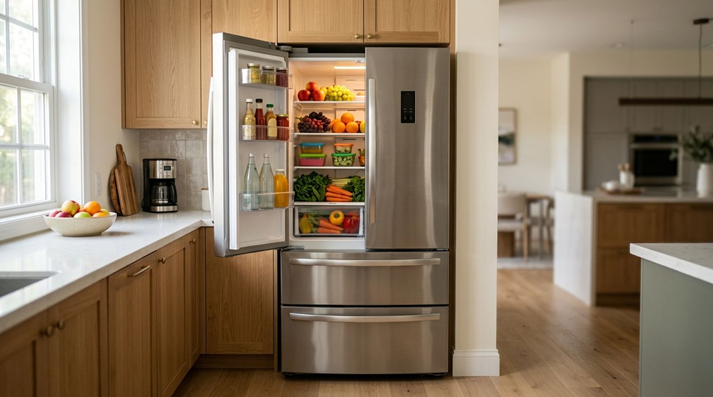
Layout drives almost every other decision, so it deserves the first serious thought. A top-freezer model keeps the classic proportions and tends to be the most energy-efficient configuration because the coldest compartment sits above the warmer one, which suits how heat naturally moves. A bottom-freezer model puts fresh food at eye level — a small ergonomic win that adds up across thousands of openings per year. French door bottom freezer designs combine two narrow fridge doors on top with a pull-out freezer drawer below, which is convenient in narrow kitchens because each door swings through a smaller arc.
Side-by-side models split the cabinet vertically, with fridge on one side and freezer on the other. They look impressive and offer easy access to frozen goods, but they come with a trade-off worth knowing: side-by-side refrigerator-freezers and models equipped with through-the-door ice typically consume more energy than other configurations, according to the U.S. Department of Energy. For households that rarely use ice dispensers, a simpler layout often delivers the same usable space with lower running costs.
The scale of this choice is easy to underestimate. The European Commission reports that in 2020, 258 million household refrigerators and freezers were in use across the EU27 — a reminder that even small per-unit efficiency differences translate into significant collective energy demand. Picking the right layout is therefore both a personal and a broader decision.
Cooling Technology: What Actually Keeps Food Fresh
Cooling technology is where marketing language gets thickest, so it helps to focus on three concrete things. First, the compressor: an inverter compressor varies its speed to match demand, instead of switching fully on and off. That means fewer temperature swings inside the cabinet, less noise, and lower long-term energy use — the fridge does less work to hold a steady climate.
Second, the airflow system. A fridge with double doors benefits enormously from multi-airflow or twin-cooling designs, because each compartment can be kept at its own humidity level. Freezers need very dry air to prevent freezer burn; fresh food compartments need moist air to keep vegetables crisp. If both compartments share one airstream, one of them is always compromised. Twin systems solve that by running separate evaporators or carefully directed vents.
Third, defrost behaviour. No-frost (frost-free) technology circulates cold air to prevent ice buildup on freezer walls, which means the freezer keeps its rated volume over years of use instead of shrinking behind a layer of ice. The mechanism is straightforward: a small fan pulls humid air past a cold evaporator coil, condenses the moisture there, and periodically melts it away. The pay-off is real — no manual defrosting weekends — but the fan does add a very small amount of noise, which brings the next point into view.
Size, Capacity and Fit: Measure Twice, Buy Once
Capacity numbers on a spec sheet rarely tell the full story. A 500-litre refrigerator with poor internal layout can hold fewer weekly groceries than a well-designed 400-litre model. What matters more than the total is the split between fridge and freezer, and how the shelves and drawers divide that volume.
A worked example makes this concrete. Consider a family of four that shops once a week and freezes bulk purchases. They typically need around 100 litres of fresh-food volume per person plus roughly 60 litres of freezer space per person — so about 400 fresh and 240 frozen, or a 640-litre total with a roughly 60/40 split. A couple who eats out often and cooks fresh might do better with 350 litres total and a smaller freezer. Matching the split to actual habits prevents the classic problem of a stuffed fridge sitting next to a half-empty freezer.
Physical fit is the other half of the equation. French door refrigerator dimensions vary between manufacturers, and depth in particular is worth checking: counter-depth models sit almost flush with cabinets but hold less than standard-depth units of the same width. LG refrigerator dimensions, Samsung 3 french door refrigerator specs, and GE appliance refrigerator listings all publish detailed width, height and depth figures — but the numbers only matter once the kitchen niche, doorway width, and hinge clearance have been measured. Doors need room to open past 90 degrees so drawers can slide out fully; a fridge that fits the niche but can’t open its crisper is a daily annoyance.
| Layout | Typical strength | Typical trade-off |
| Top freezer | Best energy efficiency, lowest price | Freezer at eye level, less fridge access |
| Bottom freezer | Fresh food at eye level | Bending for frozen items |
| French door | Narrow door swing, wide shelves | Higher price, deeper cabinet |
| Side-by-side | Easy freezer access, ice options | Higher energy use, narrow shelves |
Energy, Noise and the Details That Age Well
Energy consumption deserves attention beyond the sticker. The energy label gives an annual kWh estimate under standardised conditions, but real-world use depends heavily on ambient kitchen temperature, how often the doors open, and whether the condenser coils stay clean. A model rated one class higher may cost more upfront but pay back over its lifespan — refrigerators typically run for well over a decade, so even small daily differences accumulate.
Noise is the feature most buyers regret ignoring. A refrigerator in an open-plan kitchen is audible whenever the room is quiet. Look for the decibel figure on the spec sheet; the lower, the better, and inverter compressors generally run quieter than fixed-speed ones. Independent tests and GE french door refrigerator reviews often highlight noise as a decisive factor once other specs are comparable.
Finally, the small features that only matter after installation: door-in-door compartments for frequently used items, humidity-controlled crisper drawers, flat hinges that let the appliance sit close to the wall, an interior water dispenser instead of a through-the-door one (less energy loss), and shelves that can be reconfigured without tools. None of these appear in headline marketing, but together they define whether the appliance still feels well-designed after five years. The order matters too: get the layout and cooling technology right first, then size, then energy and noise, and only then the convenience details. Reversing that order is how kitchens end up with a beautiful appliance that runs loud, costs too much to operate, and doesn’t quite fit the weekly shop.