




Table of Contents
ToggleConverting a single room to serve both as a home office and guest bedroom isn’t just clever, it’s essential for homeowners working with limited square footage. The challenge lies in creating a space that functions seamlessly for focused work while offering genuine comfort when overnight visitors arrive. With the right furniture selections, layout strategies, and a few design tricks borrowed from commercial hotel planning, a guest room office combo can outperform two separate rooms. This guide covers practical office and guest room ideas that balance productivity with hospitality, from wall-mounted desks that disappear when company arrives to lighting plans that support both spreadsheet work and restful sleep.
Key Takeaways
- Office guest room ideas prioritize multi-functional furniture like Murphy beds and fold-down desks to maximize limited square footage while maintaining both productivity and hospitality.
- Murphy beds require secure wall stud anchoring with lag bolts and approximately 8×6 feet of clear floor space when deployed, making them the gold standard for space-efficient guest room office combinations.
- Effective zoning through area rugs, accent wall colors, and strategic lighting layers (cool 4000-5000K for work, warm 2700-3000K for rest) creates psychological separation between work and sleep functions without building permanent walls.
- Electrical planning is essential before setup—office areas typically need 4-6 outlets within desk reach, often requiring licensed electrician installation since most bedrooms lack adequate circuits for modern work equipment.
- Window treatments combining blackout cellular shades with sheer curtains, plus solid-core doors with weatherstripping, control light, privacy, and sound simultaneously for uncompromised work focus and guest sleep quality.
Why Dual-Purpose Rooms Are Essential in Modern Homes
Real estate costs continue climbing while average home sizes shrink in urban and suburban markets. Most homeowners can’t dedicate separate rooms to occasional guests and daily work, making the office guest room combo a practical necessity rather than a design trend.
Dual-purpose rooms deliver measurable value. A well-executed small guest room office combo maintains property resale appeal by preserving bedroom count (crucial for appraisals) while providing functional workspace that remote workers and side-hustlers actually need. Unlike purely decorative spaces, these rooms earn their square footage every single day.
The pandemic accelerated remote work adoption, but municipal zoning and building codes haven’t caught up. Most residential zones don’t require permits for interior room conversions unless they involve structural changes, plumbing, or electrical panel upgrades. But, homeowners should verify local requirements before starting any project, especially if planning built-ins that might affect wall studs or load-bearing elements.
Successful dual-purpose design requires honest assessment of usage patterns. If guests visit monthly, the room needs equal emphasis on hospitality and work. If visitors arrive twice yearly, the workspace can dominate with temporary sleeping solutions. Neither approach is wrong: the key is matching design intensity to actual usage rather than aspirational hosting schedules.
Smart Furniture Choices That Maximize Functionality
Furniture selection makes or breaks small office guest room ideas. Standard beds consume 40-60 square feet of floor space that sits unused most of the year, while traditional executive desks offer no flexibility when guests arrive. Multi-functional pieces solve both problems.
Murphy Beds and Wall Beds for Space Efficiency
Murphy beds (also called wall beds) remain the gold standard for guest room office combinations. Modern mechanisms use gas pistons or spring assemblies rated for 1,500+ lift cycles, far outlasting the squeaky hardware from decades past. Full-size units require a clear floor area of approximately 8 feet by 6 feet when deployed, with 16 inches of wall depth for the cabinet.
Installation involves anchoring the bed frame directly to wall studs using lag bolts (typically 5/16-inch diameter, 3-inch length minimum). Drywall anchors alone won’t support the 200-300 pound weight of the bed mechanism plus mattress. If wall studs don’t align with the desired bed position, installing a 2×6 or 2×8 ledger board between studs provides a secure mounting surface. This counts as structural modification in some jurisdictions and may trigger permit requirements.
For renters or those avoiding wall penetration, freestanding Murphy bed units exist but sacrifice some floor space to the supporting cabinet structure. These typically include integrated shelving or a fold-down desk on the exterior face, turning the closed bed into functional office furniture.
Daybed or sofa bed alternatives work in rooms 10×10 feet or larger. Quality mechanisms matter, cheap sofa beds with serpentine springs and thin mattresses leave guests with back pain. Look for units with 8-way hand-tied springs or sinuous wire systems and mattresses at least 5 inches thick. These run $800-2,500 depending on upholstery quality and mechanism grade.
Convertible Desks and Multi-Use Storage Solutions
Wall-mounted fold-down desks reclaim floor space when not in use. Simple DIY versions can be built from a 3/4-inch plywood or hardwood panel (24-30 inches deep, 36-48 inches wide) attached to the wall with piano hinges and supported by folding shelf brackets rated for at least 150 pounds. When folded up, the desk surface becomes a nearly flush wall panel.
Commercial fold-down desks include integrated cable management and built-in outlets, worth considering for setups requiring multiple monitors or charging stations. Route cables through 1-inch diameter holes drilled near the rear edge of the desktop, with a cord grommet to prevent chafing.
Mobile desks on locking casters offer flexibility without permanent installation. A C-shaped desk (also called a laptop cart or overbed table) can slide partially over a daybed, maximizing usable space in tight quarters. Industrial models with steel frames handle dual monitors and docking stations better than flimsy residential versions.
Storage should serve both functions. Modular cube systems (like the common 13-inch cube organizers) can hold office supplies in fabric bins while providing open shelves for guest belongings. A 6-foot tall bookshelf with a mix of closed cabinets (bottom third) and open shelving (upper two-thirds) keeps work clutter concealed when guests arrive.
Avoid furniture that tries to do too much. Desks with hidden Murphy beds sound clever but often deliver a mediocre workspace and an uncomfortable sleeping surface. Choose pieces that excel at their primary function, then add convertibility.
Design Strategies to Balance Work and Comfort
An office guest room shouldn’t feel like sleeping in a cubicle or working in a bedroom. Thoughtful design creates psychological separation between the two functions even when they occupy the same physical space.
Creating Distinct Zones Without Sacrificing Style
Physical dividers establish boundaries without building walls. A freestanding bookshelf (open-back style, 5-6 feet tall) positioned perpendicular to a wall creates visual separation while maintaining light flow and an open feel. These don’t require structural support but should be anchored to the wall with furniture straps or L-brackets to prevent tipping, especially important in households with kids or pets.
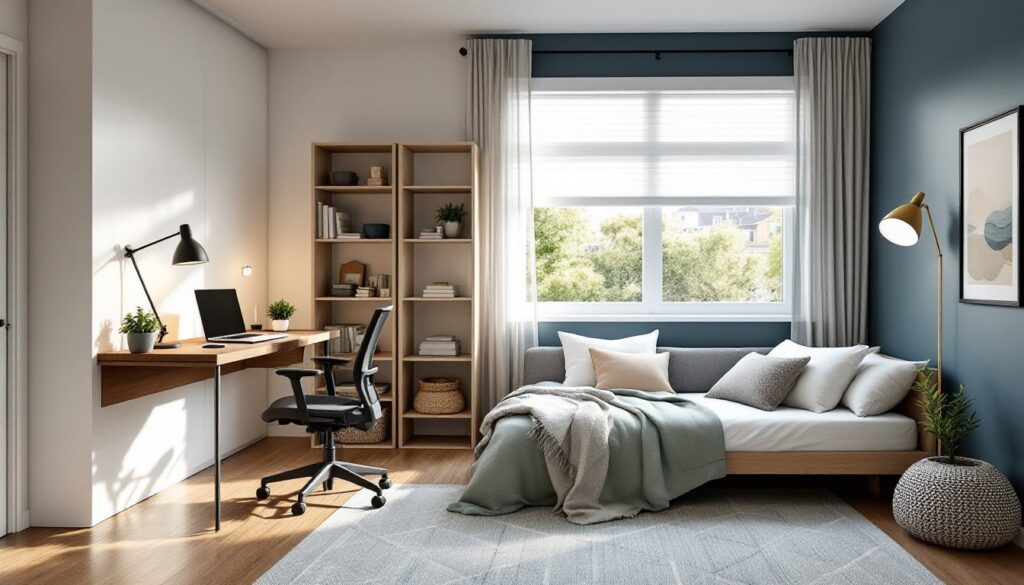
Area rugs define zones effectively in small guest room office combo spaces. Place a 5×7 or 6×9 rug under the desk and office chair to delineate the work area, leaving the sleeping zone with bare flooring or a separate rug. This simple tactic signals the functional boundary and protects flooring from chair casters.
Paint or wallpaper can emphasize different zones. An accent wall behind the desk in a deeper or contrasting color reinforces the work area, while keeping the sleeping zone in lighter, calming neutrals. Avoid busy patterns in dual-purpose rooms, they create visual noise that works against both productivity and relaxation.
Lighting layers matter more in combo spaces than single-purpose rooms. The workspace needs task lighting delivering 300-500 lumens at desk height (a desk lamp with LED bulbs in the 40-60 watt equivalent range). The guest area requires softer ambient lighting, consider a dimmer switch on overhead fixtures or table lamps with three-way bulbs (50/100/150 watts) for adjustable brightness.
Color temperature affects mood and functionality. Office areas benefit from 4000-5000K (cool white) bulbs that reduce eye strain during screen work. Guest zones should use 2700-3000K (warm white) for a relaxing atmosphere. Mixing color temperatures in one room sounds chaotic, but it actually reinforces zoning when done deliberately.
Textiles add comfort without permanent commitment. Swap out throw pillows and blankets when transitioning from office to guest mode. Keep a basket of guest-friendly linens in a closet, ready to deploy. This takes five minutes and transforms the room’s purpose more effectively than furniture rearrangement.
Layout and Lighting Tips for Office Guest Rooms
Room dimensions dictate layout options. Measure the space carefully, actual room dimensions often differ from floor plans by 2-4 inches due to drywall thickness and settling.
For rooms 10×10 feet or smaller, place the desk against the longest wall with the Murphy bed or daybed on the opposite wall. This creates a natural flow and keeps the desk from feeling crammed into a corner. If the room has a window, position the desk perpendicular to it rather than facing directly into the light (causes screen glare) or with the window behind (creates shadows on work surfaces).
Rooms 10×12 feet or larger can accommodate L-shaped or parallel arrangements. An L-shaped desk in one corner leaves ample floor space for a full-size Murphy bed or a daybed with trundle. Parallel layouts work when the room exceeds 12 feet in width, desk along one wall, bed along the opposite, with a 3-4 foot clearance between them for comfortable movement.
Electrical planning deserves attention before furniture placement. Office setups typically need 4-6 outlets within reach of the desk for computers, monitors, charging stations, and task lighting. Most bedrooms were wired for minimal electrical loads (a lamp and alarm clock), so homeowners may need to add circuits. Running new electrical requires permits in most jurisdictions and should be handled by a licensed electrician, especially if the panel is at capacity.
Window treatments must balance privacy, light control, and energy efficiency. Blackout cellular shades provide room-darkening for guests while offering insulation value (R-value around 2-4 depending on cell depth). Pair them with sheer curtains on a separate rod for daytime privacy without blocking natural light during work hours. Motorized shades add convenience but require either battery power or running low-voltage wiring, a good DIY project if the homeowner is comfortable with basic electrical work.
Climate control affects both work focus and sleep quality. If the room doesn’t have dedicated HVAC vents or baseboard heating, a portable heater or window AC unit becomes necessary. Ensure any supplemental heating or cooling is on its own circuit and not overloading existing wiring. A 15-amp circuit can safely handle about 1,440 watts continuous load (accounting for the 80% rule in the National Electrical Code).
Finally, don’t forget sound management. Offices need quiet for focus: guests need it for sleep. Solid-core doors (1-3/4 inches thick) block more sound than standard hollow-core doors. Adding weatherstripping around the door frame and a door sweep at the bottom further reduces noise transmission. For serious noise issues, consider applying acoustic panels (fabric-wrapped fiberglass) to one wall, they double as design elements when chosen in complementary colors.
A well-planned office guest room combo respects both functions equally, delivering a workspace that supports productivity and a guest experience that doesn’t feel like an afterthought. With smart furniture, intentional zoning, and attention to practical details, even a modest-sized room can serve double duty without compromise.