




Table of Contents
ToggleWhite kitchen cabinets are a homeowner’s blank canvas, versatile, bright, and forgiving. But without the right backsplash, they can feel flat or unfinished. The backsplash tile for kitchen with white cabinets does more than protect walls from splatter: it defines the room’s character, whether that’s modern farmhouse, sleek contemporary, or bold eclectic. From classic subway tile to vibrant patterns that steal the show, the best backsplash for white kitchen spaces balances style with function. The challenge isn’t finding options, it’s narrowing them down. This guide walks through proven backsplash ideas for kitchen with white cabinets, covering materials, installation considerations, and how each choice plays with light, grout, and countertops.
Key Takeaways
- White cabinet kitchen backsplash ideas offer endless design flexibility because white cabinets act as a neutral backdrop that lets the backsplash become the true focal point of your kitchen.
- Classic 3×6-inch subway tile remains the most affordable and beginner-friendly backsplash option for white kitchens, with grout color choices like charcoal gray providing contrast and hiding stains better than white grout.
- Bold patterns and vibrant colors—from geometric encaustic tiles to cobalt glass and large-format ceramics—create stunning visual impact against white cabinets without the risk of overwhelming darker kitchen designs.
- Natural stone backsplashes like Carrara marble and quartzite elevate white kitchen spaces into luxury territory, though they require regular sealing and careful maintenance to prevent etching and staining.
- Modern minimalist white kitchen backsplash designs use large-format porcelain slabs or subtle textures to let materials and craftsmanship shine, while skipping busy patterns for a sleek, maintenance-friendly aesthetic.
Why White Cabinets Offer Endless Backsplash Possibilities
White cabinets act as a neutral backdrop, which means the backsplash becomes the focal point without visual competition. Unlike darker cabinetry that locks a kitchen into a narrow color palette, white gives designers and DIYers room to experiment with bold hues, intricate patterns, or dramatic veining in natural stone.
This flexibility extends to resale appeal. A white kitchen with a well-chosen backsplash appeals to a broader buyer pool because the backsplash can be swapped or updated without reworking the entire kitchen. It’s easier to justify a vibrant turquoise mosaic when the cabinets won’t clash.
White also amplifies light, making smaller kitchens feel larger. Pairing white cabinets with a glossy or reflective backsplash, like glass tile or polished marble, bounces natural and artificial light around the room. Matte finishes and textured stone, on the other hand, soften the brightness for a cozier feel.
One caution: white-on-white schemes can look sterile if there’s no contrast. Grout color, tile texture, and countertop material all play a role. A white subway tile with dark gray grout adds definition: an all-white install with white grout works best when countertops or hardware introduce color or pattern.
Classic Subway Tile Backsplashes for Timeless Appeal
3×6-inch subway tile remains the go-to backsplash for kitchen with white cabinets, and for good reason. It’s affordable (often $1–$5 per square foot), easy to install for beginners, and pairs with nearly any design style. The rectangular format reads as clean and orderly, which complements the straight lines of Shaker or flat-panel white cabinets.
Layout matters more than most DIYers realize. The standard running bond (brick) pattern is safe and traditional. A vertical stack (tiles aligned in columns) feels more contemporary and elongates walls. Herringbone and chevron layouts add movement but require precise cuts at edges, plan for 15–20% material waste and use a wet tile saw for clean angles.
Grout selection shifts the whole look. White grout blends for a seamless, minimalist effect but shows stains in high-traffic areas near the stove. Medium gray or charcoal grout provides contrast and hides grime. Grout lines should be ⅛ inch for a modern feel or ¼ inch for a more rustic, handmade look. Use unsanded grout for tight joints, sanded for wider spacing.
Subway tile comes in ceramic, porcelain, and glass. Porcelain is denser and more stain-resistant, better for areas behind the range. Ceramic is cheaper and fine for low-splash zones. Glazed finishes are easiest to clean: unglazed requires sealing.
One pro tip: extend subway tile all the way to the ceiling or upper cabinets instead of stopping at the standard 18-inch height. It costs more in materials but eliminates the awkward painted strip above the backsplash and makes ceilings feel higher.
Bold Pattern and Color Choices That Pop Against White
White cabinets can handle backsplash drama that would overwhelm a darker kitchen. This is where homeowners inject personality, geometric patterns, saturated colors, and artisan tiles that function as kitchen art.
Geometric and Moroccan-Inspired Tiles
Encaustic cement tiles and zellige (hand-cut Moroccan clay tiles) bring texture and Old World craftsmanship. Cement tiles come in intricate geometric patterns, hexagons, star-and-cross, quatrefoil, often in two to four colors per tile. They’re porous and require sealing with a penetrating sealer before grouting and annually thereafter. Expect to pay $8–$20 per square foot.
Zellige tiles have an uneven, glossy surface with color variation from tile to tile. That irregularity is the appeal, but it complicates installation. Grout lines won’t be perfectly uniform, and tiles may need slight shimming to avoid lippage. Use a flexible thinset mortar to accommodate the handmade inconsistencies.
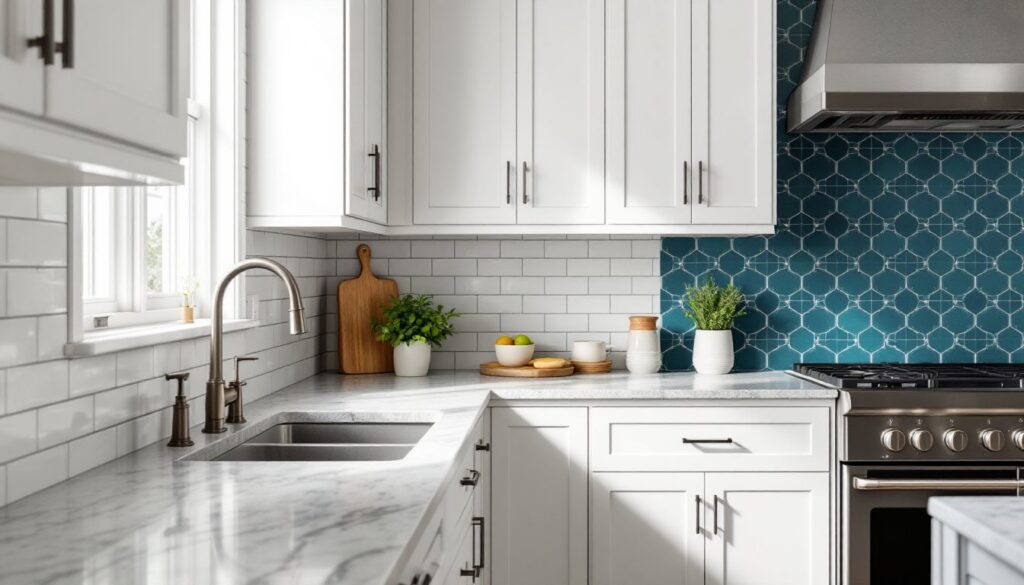
Hexagon and arabesque (lantern-shaped) mosaics offer pattern with less commitment. Mesh-backed sheets speed installation, and the smaller scale works in compact kitchens. Dark blue, emerald green, or terracotta hues contrast sharply with white cabinets without feeling cartoonish.
One layout trick: run patterned tile only behind the range as a backsplash focal wall, then use simple subway or solid tile elsewhere. It controls cost and keeps the design from feeling chaotic.
Vibrant Glass and Ceramic Options
Glass tile in saturated colors, cobalt, teal, lime, or coral, adds a modern punch and reflects light beautifully. Glass is nonporous, so it won’t stain, but it shows every smudge and water spot. Use a white thinset (gray shows through translucent tile) and clean with a non-abrasive cleaner.
Large-format ceramic tiles in solid, bold colors simplify installation. A 4×12-inch or 6×12-inch tile in navy, sage, or mustard can cover a backsplash in a couple of hours with fewer grout lines to maintain. Finish edges with a Schluter strip or bullnose trim for a clean look.
Don’t shy away from black or charcoal tile. It sounds counterintuitive with white cabinets, but the high contrast is striking and hides splatter better than light grout. Pair it with stainless steel appliances and matte black hardware for a cohesive modern look.
Natural Stone and Marble Backsplashes for Elegance
Natural stone elevates white kitchen cabinets backsplash ideas into luxury territory. Marble, travertine, and quartzite offer unique veining and color variation that no two installations replicate. It’s a premium choice, materials run $10–$40+ per square foot, plus professional installation is often worth the cost due to the stone’s weight and fragility.
Carrara marble is the classic pairing with white cabinets: soft white background with gray veining. It’s elegant but requires maintenance. Marble is porous and can etch from acidic foods (tomato sauce, lemon juice). Seal it with a stone sealer every 6–12 months, and wipe spills immediately. Some homeowners embrace the patina that develops: others find it stressful.
Honed marble (matte finish) hides etching better than polished and feels more casual. Polished marble is formal and reflects light but shows every fingerprint.
For a dramatic look, specify book-matched slabs, two adjoining slabs cut from the same block and opened like a book to mirror the veining. It’s pricey and requires a fabricator, but the symmetry is stunning behind a range or sink.
Travertine has an earthy, textured surface with natural pitting. It’s more forgiving than marble and slightly less expensive, but those pits can trap grease. Filled and honed travertine is easier to maintain.
Quartzite (not to be confused with quartz, which is engineered) is harder and more stain-resistant than marble, with similar veining. It’s a smart middle ground for homeowners who want the marble look with less upkeep.
Stone works best in large-format tiles or slabs (12×24-inch or larger) to minimize grout lines. Use epoxy grout, which resists staining better than cement-based grout, especially in light colors.
Modern Minimalist Backsplash Designs
Minimalism doesn’t mean boring, it means intentional. In a white-cabinet kitchen, a minimalist backsplash uses subtle texture, monochrome palettes, and clean lines to let materials and craftsmanship shine.
Large-format porcelain slabs (up to 5×10 feet) create a seamless, grout-free look. They’re installed like countertops, often requiring a professional with specialized tools, but the result is sleek and easy to clean. Porcelain can mimic marble, concrete, or even wood grain with photorealistic printing.
White or light gray zellige or handmade tile in a simple subway or square format adds quiet texture. The slight irregularities and glaze variation keep it from looking flat, but the neutral palette maintains calm.
Concrete-look tile or actual troweled concrete (sealed properly) delivers an industrial-minimalist vibe. It pairs well with butcher block or concrete countertops and matte black fixtures. True concrete requires a skilled installer and proper sealing to prevent staining.
Stainless steel or metal tiles in brushed or matte finishes work in ultra-modern kitchens. They’re heat-resistant and practical behind cooktops, though they scratch and dent more easily than ceramic.
For the ultimate minimalist move, skip tile altogether and use painted drywall with high-gloss or semi-gloss paint in a light neutral. It’s the least expensive option and works if the backsplash area sees minimal splatter. Use kitchen and bath paint with mildew resistance, and be prepared to touch up occasionally.
In minimalist designs, the absence of pattern puts pressure on execution. Grout lines must be laser-straight, and tile cuts need to be precise. A single crooked row or chipped edge stands out. Use a laser level, take time with layout, and consider hiring a pro for the install even if materials are DIY-budget-friendly.